
This is an old revision of the document!
Table of Contents
Marcus Camby's collapse, January 1996
Jan. 15 Globe
UMass hoop star Camby collapses
By Michael Vega, The Boston Globe Staff, 1/15/1996
Globe correspondent John Anderson contributed to this report.
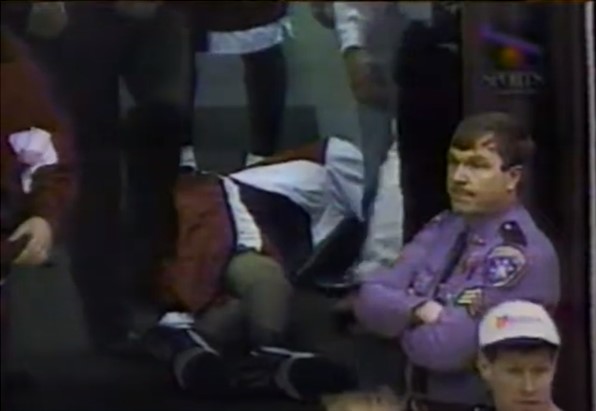 OLEAN, N.Y. – Marcus Camby, the best player on the top-ranked University of Massachusetts men's basketball team, was admitted for observation into Olean General Hospital last night, where he remained alert and conscious and in stable condition after collapsing minutes before the tipoff of yesterday's Atlantic 10 conference game against St. Bonaventure.
The episode came just five days after the death of UMass swimmer Greg Menton, who died of cardiac dysrhythmia during a swim meet at Dartmouth Jan. 9.
“All this is a little mind-boggling,” said UMass sports information director Bill Strickland. “It's been a rough week. To see Marcus go down like that, there are things running through your mind, and they're not very pleasant things.”
UMass coach John Calipari, who missed yesterday's 65-52 victory after he rode in the ambulance and stayed at the hospital with his stricken star, said Camby underwent a battery of tests, which all proved negative, and will undergo more testing this morning before he is released. Camby will join his teammates, who visited him in the hospital yesterday afternoon before busing to Buffalo, where they spent the night, for today's 11 a.m. return flight.
“They've eliminated probably 100 things by doing the tests,” said Calipari in a short meeting with the media in the hospital lobby last night. “They don't have exactly the reason for the collapse and they want to do more tests before they commit to anything. But he will stay overnight for observation.
“He wanted to go back with the team,” Calipari added, “but we, along with the physicians at the hospital, encouraged him that it was best for him to stay.”
Donna Oehman, the attending emergency room physician, declined to comment on Camby's condition, deferring all questions to UMass officials. UMass trainer Ron Laham, who accompanied Calipari to the hospital, indicated Camby was given an electrocardiogram and a CAT scan.
“Preliminary indications are that both tests went well,” Laham said.
Calipari said Camby had been suffering from a chest cold and, according to Laham, was taking some Robitussin cough medicine. During pregame warmups at the Reilly Center, Camby became light-headed and walked off the court on his own. The junior center from Hartford attempted to make his way to the UMass locker room, where the coaches were huddled, when he collapsed in a hallway near the court.
“We were all in the locker room and didn't see it,” said a pensive Calipari as he sat with Laham in the waiting area of the hospital's emergency room shortly after Camby's arrival. “Donta Bright came running in and told us to hurry out into the hallway because Marcus had gone down.”
“I was standing next to him in the hallway and he was kind of holding his head and the side of his face when he just suddenly fell,” said Bright after yesterday's game. “As soon as it happened, I ran out and got word back to one of the coaches and one of the trainers.
“I was scared.”
The incident brought to mind the episode two years ago when former UMass guard Mike Williams collapsed on the floor during a game at Cincinnati. After an extensive battery of tests revealed no cardiac problems, Williams was cleared to play two weeks later with doctors saying it was most probably “a common faint in association with a mild respiratory infection and dehydration.”
Yesterday, however, no one was willing to make a definitive statement about the reason for Camby's collapse.
“We just know that he's fine now and the preliminary indications are that all the tests went well,” said Laham. “He's looking and feeling much better now.”
Laham, who credited the quick response of St. Bonaventure's team physician and trainer along with local emergency medical technicians, said when he arrived at Camby's side the player was semiconscious.
“He didn't look too responsive,” Laham said. “He looked like he was kind of out there. He didn't recognize us at first, but when we got him to the hospital he came around and recognized Coach Calipari and myself and was alert and conscious. But he looks much better now than when we brought him in.”
Mark Belli, an EMT with the Allegheny Volunteer Fire Department, said it took eight men to load the 6-foot-11-inch, 220-pound Camby into the ambulance “because we didn't want to bend him in any way,” he said.
“It usually only takes two or three people to get someone in an ambulance,” Belli said. “He was semiconscious and not very alert. Coach Calipari was in the ambulance before we got Camby loaded. He was very nervous and wasn't concerned about the game.”
In fact, Camby seemed to be the only person who was concerned about the outcome of the game.
“He was in the CAT scan and he was asking about the score of the game,” said nursing supervisor Raye Green. “I told him it was halftime and UMass was up by 9.”
After the Minutemen visited Camby in the hospital, Calipari, who stayed in Olean last night along with Laham, evaded reporters by sneaking on and off the team bus to meet with his players. Afterward, the coach reluctantly agreed to make an official statement to the media.
“An incident like this puts things into perspective,” said Calipari, who did not tape his weekly television show yesterday as scheduled. “Playing basketball games is not life or death. You're talking about playing basketball. With Marcus right now, I think our team knows that their well- being is more important to me than any basketball game.
“We just hope that, by God's good grace, all these tests turn out negative and he's able to rejoin our team in the near future.”
Scene eerily familiar
Calipari flashes back to Williams incident
By Mark Blaudschun, The Boston Globe Staff, 1/15/1996
The scene was eerily familiar for John Calipari. Road game. Things looking normal. Then, all of a sudden, the game his team had come to play is rendered meaningless, its importance wiped out in the instant one of his players drops to the floor.
Some coaches will go through an entire career and not have to worry about anything more than Xs and Os during the game. For Calipari, yesterday was the worst kind of deja vu as he saw center Marcus Camby collapse in the runway leading from the court to the locker room shortly before the University of Massachusetts' game at St. Bonaventure in Olean, N.Y.
Two years ago, Calipari and the Minutemen were playing at the University of Cincinnati. Things were proceeding normally when guard Mike Williams collapsed, almost directly in front of Calipari.
Before you could say time out, Calipari was on the court, his hand on Williams' chest. “All I could think of,” said Calipari at the time, “was what happened with Reggie Lewis. Once I felt his heart still beating, I felt a little better.”
As it turned out, Williams was suffering from nothing more than respiratory infection and dehydration. But the memory of the collapse and subsequent death of Celtic star Lewis remains etched in everyone's memory, which is the main reason Calipari took a trip to the hospital with Camby yesterday instead of coaching his team.
Coaching is difficult enough without any additional problems. But these are tense times at UMass. The campus is still in a state of shock over swimmer Greg Menton, who collapsed and died during a meet at Dartmouth last week.
Injuries are part of the game, and every coach can adjust to that, as Calipari did when Camby hurt his knee during the Rainbow Classic in Hawaii last month. But those have logical explanations.
When a player seemingly in the prime of health collapses suddenly, the jolt to everyone is enormous. Having it happen to a coach once is tough enough, having it happen twice should entitle Calipari to combat pay at the very least.
As Calipari said again yesterday, such incidents can change your views quickly. “This puts things in the perspective they should be,” he said. “Basketball is not life and death.”
Unfortunately, sometimes it is, which is why what happened yesterday was so scary and uncomfortably familiar for Calipari.
Jan. 30 Collegian
Camby presumed healthy after pre-game collapse
By Candice Flemming and Justin C. Smith, The Massachusetts Daily Collegian Staff, January 30, 1996 (first publication after winter break)
Five days after the death of Massachusetts swimmer Greg Menton, Marcus Camby of the UMass men's basketball team collapsed moments before the Minutemen's basketball game against St. Bonaventure.
Camby was immediately taken by ambulance on Jan. 14 to Olean General Hospital with Massachusetts coach John Calipari by his side. Camby had been taking cough medicine to fight an illness and fell light-headed before the collapse, his coach said.
“An incident like this puts things into the perspective they should be in,” Calipari said. “Basketball is not life or death.”
Camby's heart never stopped beating and he never stopped breathing, but he was unresponsive for approximately 10 minutes, causing great concern to doctors.
Camby underwent numerous tests later that evening and the following morning, when a heart problem was ruled out. According to Calipari, that news “was like winning the Final Four.”
Camby was released from the hospital later that afternoon and transported to the UMass Medical Center in Worcester for further testing.
“I think you have to be ultra-cautious, yes,” team physician James Ralph said after Camby was admitted to the medical center.
“Any circumstance like this is unsettling to everyone, that's why they are going to do every conceivable test,” said Ralph, adding he was particularly troubled that Camby was unresponsive for 10 minutes after fainting.
Upon leaving Olean General Hospital, Camby said he felt “100 percent.”
“I'm fine, I feel great,” Camby said. “I'm anxious to get back on the court.”
At the UMass Medical Center, Camby underwent “an extensive medical evaluation and rigorous testing” according to a written statement by Dr. Gerald Steinberg, chief medical officer at the UMass Medical Center.
“Marcus' evaluation at UMass included a wide range of diagnostic procedures, as well as a review of tests down at [Olean General Hospital],” Steinberg said. “He tolerated the tests well, and as might be expected of a college athlete, his physical condition is excellent.”
Camby was released from the hospital on the morning of Jan. 18 and Steinberg said “we are able to rule out at this time a cardiac or cardiovascular cause of the event Marcus suffered with a high degree of confidence.”
Camby missed three games because of the collapse and the Minutemen have won all three without him. He traveled to Pittsburgh a day after his team and was going to suit up for the Minutemen's game against Pitt but it was uncertain if he would play at all.
Only two years ago, UMass junior guard Michael Williams collapsed during a game at Cincinnati. Tests revealed no cardiac problems and he was cleared to play two weeks later
Material from the Associated Press was used in this report.
Collapse still leaves questions
By Justin C. Smith, The Massachusetts Daily Collegian Staff, January 30, 1996
It happened twice before, but never like this.
Two years ago it was on the floor of Madison Square Garden against North Carolina, and last year it was at home versus St. Joseph's. Massachusetts center Marcus Camby lay on the floor of a basketball arena with an injury and was lost to his team for a short period of time.
Those incidents have since healed and are long forgotten. However those events are all overshadowed by the happenings on Sunday, Jan 14 in Olean, NY.
On the way back to the locker room from the pre-game shoot around, less than seven minutes before game time against St. Bonaventure, the 6-foot-11-inch National Player of the Year candidate fell motionless and unresponsive in the runway for nearly 10 minutes. Unlike his previous injuries and ailments, no concrete indication as to what happened to the superstar that day has been given.
The 21-year-old future NBA draft pick was suited up for the Minutemen’s clash with Pitt, but he didn't see action. But that does not mean that his battle is over, or does it? And what does this do for the team as a whole?
Every possible test that could determine what might have caused him to collapse has returned negative, so we know it's not neurological, cardiological or pharmaceutical. Those indicators are positive, and the doctors have cleared him to continue playing without any reservations.
But with the death of swimmer Greg Menton to a heart condition already casting a somber atmosphere over the University, how can there not be a lingering question in the minds and hearts of family, friends and fellow classmates.
Will it happen again?
Could the tests have missed something or just not be able to detect what the problem was? After all, Menton's condition was found only after his much-too-early passing. The answers to these questions we may never know until it is too late, or they may never be answered at all.
The way this team is playing, do they really need him? Since his well documented, but unaccounted for collapse, the Minutemen have played four games and come out on top in every one of them. Sure, twice they have gone to overtime, but those games were on Hawk Hill, where UMass always has a tough time defeating St Joe’s and at Pittsburgh of the Big East.
Earlier this year the Panthers completely dismantled fifth ranked Georgetown by 19 at the Fitzgerald Field house and had lost there only 11 times in the past six years. That record includes a 48-5 mark against non-conference opponents going into the UMass game.
I know the Minutemen won't go very far in the tournament without the best big man in the country, but this stretch of close games has brought out the best in the other contributors on the club.
Donta Bright has turned into the scorer we all heard he was when he came out of the best high school program in the country. Over the four games Camby has missed, Bright has averaged 21 points per game. The most impressive stretch may have been the 10 points in a 19-5 run that turned a five point deficit into a 62-53 lead for UMass against Pitt.
Carmelo Travieso is a streak shooter that has found a zone hitting 14 of his last 22 three point attempts, including at least five of those in the stretch. Dana Dingle also stepped up with a career high 24 points against Duquesne.
We may have not learned enough about the health of the UMass superstar, but if the incident turns out not to be a threatening or recurring one, it still may have been a valuable learning experience.
Justin C Smith is a Collegian columnist.